Vantage Health
The practice platform built for brain-based care, and the technology behind ours.
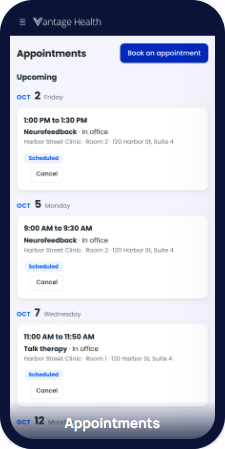
Dr. Damian helped build Vantage Health for exactly this kind of measurement-informed work. We use it to send secure intake questionnaires and psychometric assessments before your first visit, and to track your progress over time, so your sessions can focus on you and not on paperwork.
- Secure digital intake before your first visit
- Assessments scored and charted over time
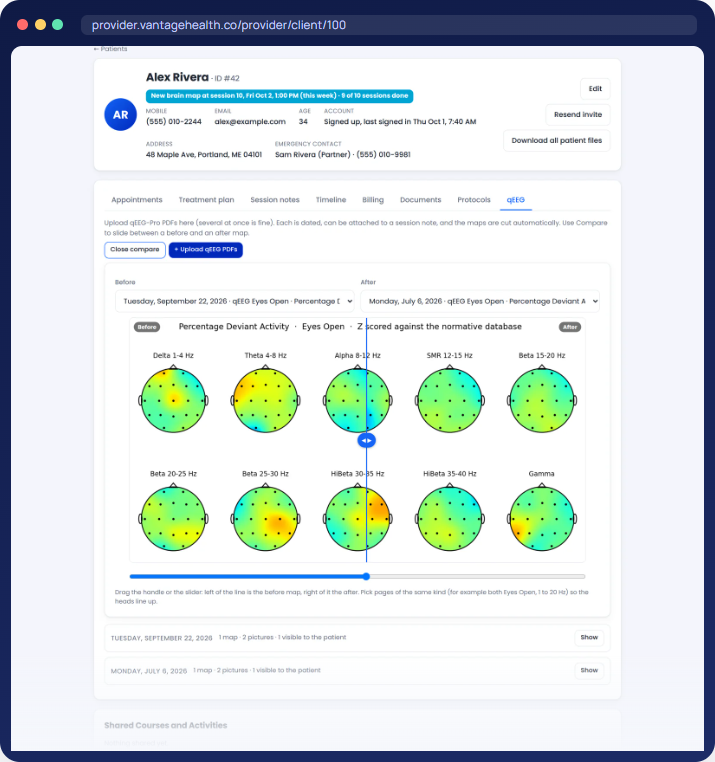
- qEEG brain maps compared before and after
Research & education
Neurofeedback and biofeedback rest on a deep, growing body of peer-reviewed research. We believe in evidence over hype — so if you like to read primary sources, these are trustworthy places to start.
ISNR Comprehensive Bibliography
Maintained by the International Society for Neuroregulation & Research, this is one of the most complete public indexes of neurofeedback studies — organized by clinical condition, spanning hundreds of peer-reviewed references, and including practice guidelines such as the widely-cited La Vaque et al. (2002) efficacy framework.
ISNR Comprehensive Bibliography
A large, condition-by-condition index of peer-reviewed neurofeedback research — ADHD, anxiety, depression, PTSD, epilepsy, TBI, and more — with a searchable, filterable interface.
Visit →ISNR
The International Society for Neuroregulation & Research — a nonprofit of clinicians and scientists advancing neurofeedback practice, ethics, and study.
Visit →Neuroregulation (journal)
ISNR’s peer-reviewed, open-access journal — primary research you can read in full, free.
Visit →AAPB
The Association for Applied Psychophysiology and Biofeedback — the professional home of biofeedback science and practice.
Visit →BCIA
The Biofeedback Certification International Alliance — the body that board-certifies practitioners (Dr. Damian is BCIA-certified in neurofeedback).
Visit →PubMed
The U.S. National Library of Medicine’s database of biomedical research. Search “neurofeedback,” “qEEG,” or “biofeedback” to read study abstracts and citations directly.
Visit →These are independent organizations; links are provided for education and don’t imply endorsement of any specific provider.
From our blog
Plain-language writing from Dr. Damian on how brains work, why they struggle, and what actually helps — no jargon required.